
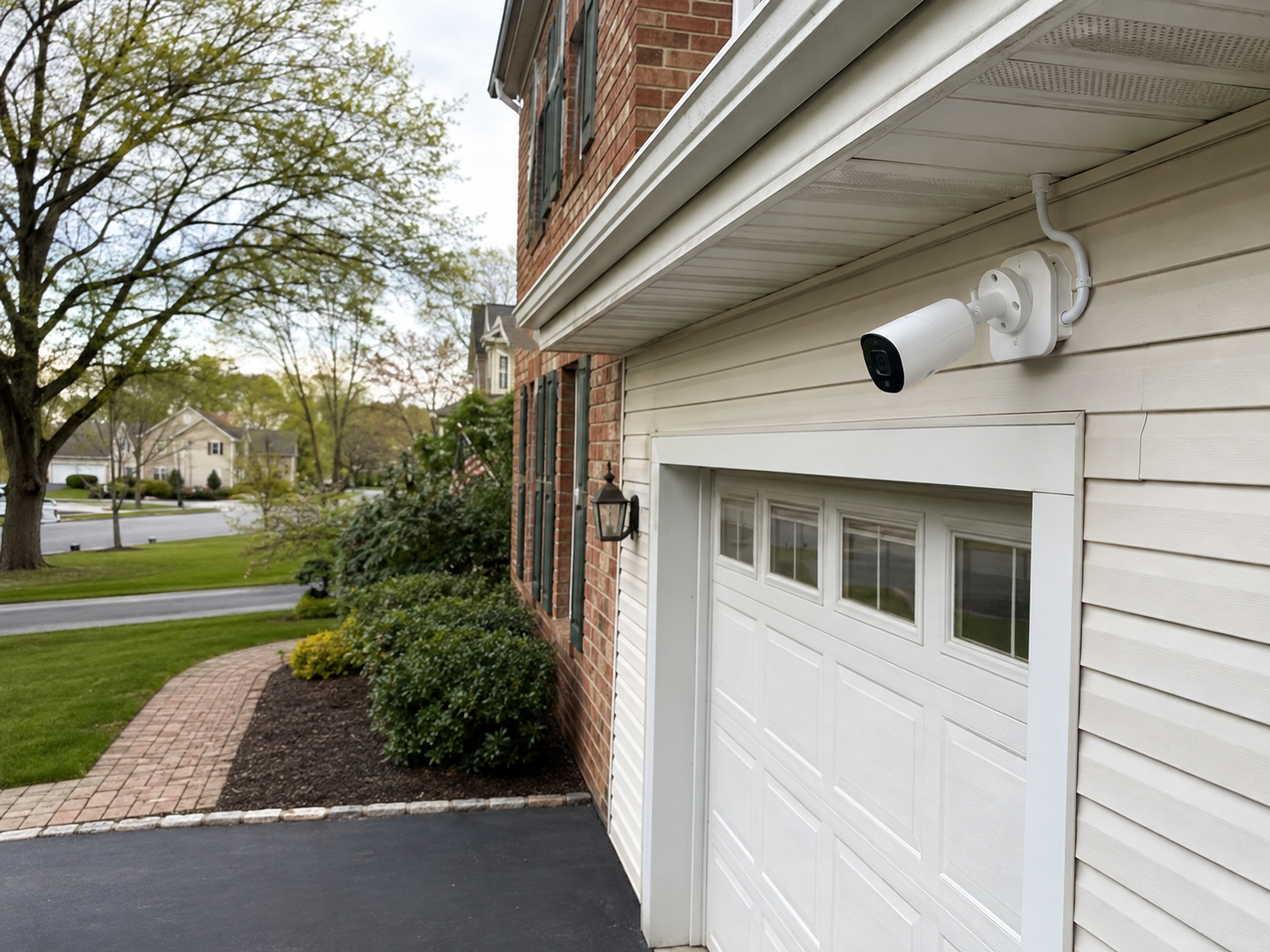
Choosing a home security system is no longer as simple as deciding where to place an alarm. Homeowners today can choose from wireless cameras, DIY systems, professionally monitored alarms, and fully hardwired video surveillance systems.
Each option has advantages, but they are not designed for the same purpose.
For homeowners in Bergen County who want reliable, long-term video surveillance, a professionally installed hardwired system offers several important advantages. Instead of relying primarily on Wi-Fi connections or battery-powered cameras, hardwired systems connect cameras directly to a dedicated recorder, allowing footage to be stored locally and recorded more consistently.
Before investing in a security system, it helps to understand how these systems differ, what equipment is involved, and what installation actually looks like.
Hardwired vs. Wireless Home Security Systems
One of the first decisions a homeowner needs to make is whether to install a wireless or hardwired system. You may want to do a wireless system until you discover that the convenience of a wireless or DIY camera masks how fragile its coverage really is. These systems have become popular precisely because they seem easy to set up—but in fact, they are easy to instal incorrectly, giving you a false sense of security. The cameras talk to a home router over Wi-Fi, and the footage lands in the cloud or on a mobile app, so within an afternoon a homeowner can feel like the property is watched over — even though that sense of protection is resting on a chain of dependencies that can easily break and without warning.
For an apartment, a rental, a smaller home, or anyone who only needs a camera or two, this kind of setup can provide coverage that feels sufficient in the moment; but the very qualities that make it convenient are the same ones that make it unreliable when it counts, since a dead battery, a dip in Wi-Fi strength, an internet outage, or nothing more than interference from a neighboring signal can silence a camera exactly when something is happening in front of it, all while the homeowner checking the app assumes everything is being recorded as promised.
A hardwired system, on the other hand, takes a fundamentally different approach. Each camera runs on a physical cable back to a central recording device, the NVR or network video recorder, and because many modern installations use Cat5e or Cat6 Ethernet cable carrying both data and power through Power over Ethernet, the cameras never depend on a battery holding its charge or a wireless signal reaching every corner of a yard. What this means, in practice, is that the recording no longer lives or dies with the strength of the home’s Wi-Fi — it simply keeps working, cable by cable, camera by camera — and for a homeowner who wants several exterior cameras, continuous and uninterrupted footage, storage that sits locally rather than trusting a cloud connection, and a system meant to hold up for years rather than months, that difference stops being a technical footnote and becomes the entire reason to choose one system over the other.
What Makes Up a Hardwired Security Camera System?
A residential hardwired security system generally includes four main components:
- IP security cameras
- Ethernet cabling
- A network video recorder
- Video storage
The quality and configuration of each component affects the reliability of the entire system.
IP Security Cameras
IP cameras capture video digitally and transmit it through the network cable to the recorder.
Residential systems commonly use cameras ranging from approximately 4MP to 8MP resolution. Outdoor cameras may also include infrared night vision and weather-resistant housings designed to withstand rain, snow, and changing temperatures.
Resolution is important, but higher resolution alone does not guarantee better security.
Camera placement, lighting, viewing angle, and lens selection can matter just as much. A properly positioned camera that captures a person’s face clearly can be more useful than a higher-resolution camera producing a wide image in which important details are difficult to identify.
Cat6 Cabling
Ethernet cabling connects each camera to the recording system.
With Power over Ethernet, a single cable can often transmit both data and electrical power. That simplifies the camera installation and eliminates the need for separate power supplies at every camera location.
Depending on the property, cables may be routed through walls, attics, basements, conduit, or exterior areas. The appropriate installation method depends heavily on the design and construction of the home.
Network Video Recorder
The NVR acts as the central hub of the system. It receives footage from the cameras, processes it, and stores it on internal hard drives. Residential NVRs may support eight, sixteen, or more camera channels depending on the size of the installation.
Choosing an NVR with additional capacity can also make it easier to add cameras later.
Video Storage
Security footage is normally stored on surveillance-rated hard drives inside the NVR. A residential system might use anywhere from approximately 2TB to 8TB of storage or more, depending on its requirements.
However, storage size by itself does not tell you how much footage the system will retain.
Retention time depends on several factors, including:
- Number of cameras
- Camera resolution
- Frame rate
- Video compression
- Continuous versus motion-based recording
- Total storage capacity
A professional installer should be able to estimate how many days of footage your proposed system will retain before installation begins.
How Many Security Cameras Does a Home Need?
There is no universal number. The appropriate number of cameras depends on the size and layout of the property, the number of access points, the surrounding landscape, and what the homeowner wants to monitor.
For many single-family homes, six to eight cameras may provide useful exterior coverage. Larger properties, detached garages, multiple structures, long driveways, or unusual layouts may require additional cameras.
Rather than starting with a camera count, it is usually better to identify the areas that need protection.
Common locations include:
- Front doors and secondary entrances
- Driveways
- Garages
- Backyards
- Side entrances
- Walkways
- Gates
- Ground-level windows
- Areas that are difficult to see from inside the home
The goal is not simply to install as many cameras as possible. The goal is to eliminate important blind spots and capture useful footage where it matters most.
What to Expect During a Professional Installation
Installing a hardwired camera system involves considerably more than mounting cameras to the exterior of a house.
A technician must determine where cameras should be positioned, identify appropriate cable routes, run cable to each location, connect the cameras to the recorder, configure the equipment, and test the system.
For a typical home, installation may take a full day. More complicated properties can require additional time, particularly when the home has finished basements, difficult attic access, older construction, masonry walls, detached structures, or challenging cable routes.
These considerations can be particularly important in Bergen County, where housing styles and construction methods vary significantly from one municipality and neighborhood to another.
Camera placement is another important part of the installation process.
An experienced installer should consider more than where a camera looks aesthetically pleasing. Factors such as sun glare, exterior lighting, tree growth, roof lines, fencing, HVAC equipment, and other obstructions can all affect the quality of the footage.
The objective should be to capture identifiable information whenever possible.
For example, a wide-angle view of an entire driveway may look impressive on a monitor, but it may be less useful if a person’s face or a vehicle’s license plate cannot be clearly identified.
A professional security assessment should therefore consider both coverage and image quality before any cameras are installed.
Homeowners should also ask whether any permits, licensing requirements, or other local regulations apply to the proposed installation. Requirements can vary depending on the municipality and the type of work being performed, so these questions should be addressed before installation begins rather than after the system is already in place.
Professional Monitoring and Police Response
Video surveillance is only one part of a complete home security strategy. Some homeowners choose to monitor their cameras themselves through a mobile app, while others integrate their cameras with a professionally monitored alarm system.
With professional monitoring, a central monitoring station can respond when an alarm is triggered. Depending on the system and monitoring service, video verification may also allow an operator to review relevant footage before contacting emergency services.
This can help distinguish a genuine security event from situations such as an animal triggering a motion sensor, a delivery driver entering the property, or another non-emergency event.
That distinction is important because repeated false alarms may result in warnings or fines in some municipalities.
Homeowners considering professional monitoring should ask their security provider several questions before signing up:
- What happens when an alarm is triggered?
- Is video verification available?
- Who contacts the homeowner?
- When are police or emergency services contacted?
- Is cellular backup available if internet service goes down?
- Are there additional monthly monitoring fees?
- Does the local municipality require an alarm registration or permit?
Requirements can vary between municipalities, so Bergen County homeowners should confirm the rules that apply specifically to their town.
Self-Monitoring vs. Professional Monitoring
A self-monitored system lets homeowners receive alerts through a mobile app, but that convenience can give them a false sense of security. It’s easy to assume that having eyes on your property means you’re covered, when in reality the entire response chain rests on a series of things going right. In the moments that count most, that’s a lot to ask of someone who isn’t trained for it, and it’s precisely in those high-stakes moments—the middle of the night, a family emergency, an intruder already inside—that a homeowner is least likely to be at their sharpest. The false sense of security comes from mistaking visibility for protection: seeing what’s happening on your property isn’t the same as having someone equipped and ready to act on it.
Professional monitoring closes that gap by adding a layer of oversight that doesn’t depend on the homeowner being available, alert, or even awake. Rather than leaving it to chance whether a notification gets seen and acted on in time, trained monitoring personnel receive the alarm signal directly and follow an established response procedure, which means someone is always watching even when the homeowner can’t be.
This is especially important for homeowners who travel frequently, who have multiple entry points or a larger property to account for, or who want their cameras integrated with burglar, fire, or other alarm systems—for these households in particular, the comprehensive coverage that professional monitoring provides isn’t just a nice-to-have but a real safeguard. Even homeowners who like the convenience of checking in on their own cameras don’t have to give that up; they can retain that access while still relying on professional monitoring to handle the alarm events themselves, getting the peace of mind of both without leaning on self-monitoring alone.
Choosing a Home Security Installer in Bergen County
Even an expensive camera system can perform poorly if cameras are positioned incorrectly, cables are improperly routed, or recording settings are not configured for the property.
When evaluating a security company, look beyond the number of cameras included in the quote.
A reputable installer should first assess the property.
That assessment should include entry points, driveways, exterior lighting, landscaping, potential blind spots, cable routes, and any areas the homeowner is particularly concerned about.
Be cautious about accepting a complete installation recommendation based entirely on a phone conversation.
While an installer may be able to provide a general price range remotely, an on-site walkthrough allows the company to see the actual conditions that will affect camera placement and installation difficulty.
Local experience can also be useful.
Bergen County contains everything from older colonials and split-level homes to newer construction and larger properties with detached garages or extensive landscaping. Different homes can create very different installation challenges.
An installer familiar with the area is more likely to understand these construction differences and identify practical cable routes before work begins.
Homeowners should also confirm that the contractor holds any licenses required for the work being performed and carries appropriate insurance.
Is a Hardwired Security System Worth It?
For some homes, a simple wireless camera system may provide everything the homeowner needs.
For others, particularly larger properties or homes where consistent video coverage is important, a professionally installed hardwired system can offer significant advantages.
Hardwired systems are particularly well suited for homeowners who want:
- Continuous video recording
- Multiple exterior cameras
- Local footage storage
- Reduced dependence on Wi-Fi
- Fewer battery-powered devices
- Professional camera placement
- The ability to expand the system
- Integration with professionally monitored security systems
The trade-off is primarily installation.
A hardwired system generally requires more planning, more installation work, and a higher initial investment than purchasing several wireless cameras from a retailer.
For homeowners who expect to remain in their property for several years, however, that upfront investment can provide a more permanent security infrastructure.
Getting the Right System for Your Bergen County Home
There is, of course, no single security system that is right for every home. A smaller property may only need a few strategically positioned cameras. A larger home with multiple entrances, a long driveway, a detached garage, or extensive outdoor space may require a more comprehensive design.
The best place to start is with the property itself. A professional security assessment can identify vulnerable areas, potential camera locations, blind spots, installation challenges, and the amount of recording capacity required.
Gladiator Alarms works with homeowners throughout Bergen County to design and install hardwired video security systems based on the layout and security needs of each property. However, rather than starting with a predetermined package, the goal should be to determine what your home actually needs.
If you’re considering a professionally installed security system, schedule a property walkthrough with Gladiator Alarms to see what a hardwired setup could look like for your home.

Mike has been in the industry since 2000. After working for local Bergen County-established electrical contractors and completing a 5-year state-sanctioned apprenticeship program, Mike became a foreman for a large company where he remained for over a decade. As an accomplished Martial artist in Brazilian jiu jitsu , Muay Thai & boxing Mike has learned focus, tolerance, fairness, humbleness, discipline and personal growth.
Leave a Reply