
If you have a business in Bergen County, you’ve probably considered security cameras. However, there is a world of difference between the wireless camera you might stick on your porch at home and what a commercial property really needs. This guide covers hardwired commercial security systems, why they are better than DIY setups, and what your options look like.
DIY Cameras Weren’t Built for Businesses
Consumer cameras are designed for convenience. You pull them out of the box, connect them to your Wi-Fi, and you’re recording within minutes. However, they are unreliable and not great for protecting a retail store, warehouse, or office building.
DIY systems rely on your Wi-Fi network to send footage to the cloud. If your internet goes down, so does your coverage. Add in a dozen or more cameras, and consumer-grade Wi-Fi routers simply can’t handle the bandwidth without lag or dropped frames.
There’s also the security angle to consider. Wireless cameras operate on radio frequencies that can be jammed or intercepted with low-cost, off-the-shelf equipment. That’s a real vulnerability for a business with cash, inventory or sensitive customer data.
What “Hardwired” Actually Means
Each camera is connected to a central recorder by physical cables in a hardwired system. No Wi-Fi signal to jam, no wireless drop out, no battery to die at the worst possible moment. The cable carries both power and data. This brings us to the most common setup in commercial installations today.
Most modern hardwired systems use Power over Ethernet, or PoE. A single Ethernet cable delivers electricity to the camera and carries the video feed back to the recorder. That means no separate power outlet needed near every camera, which saves a lot of headache during installation, especially in older Bergen County buildings that weren’t wired with security in mind.
The tradeoff is that hardwired installation requires more planning. The cables have to go through walls, ceilings or conduit. But that work up front is why the system is good for years, not only until the next Wi-Fi outage.
Analog vs. IP: The Two Main Hardwired Paths
Not all hardwired systems are the same. There are two main categories, and the difference matters for image quality and future flexibility.
Analog CCTV systems use coaxial cable and connect to a DVR, or digital video recorder. This is the older technology, but it’s still around because it’s cheap and reliable for basic coverage. Resolution tends to top out lower than newer systems, so fine detail like license plates or faces at a distance can be harder to capture.
IP camera systems use Ethernet cable, usually with PoE, and connect to an NVR, or network video recorder. These cameras process video digitally before sending it, which allows for much higher resolution, smarter analytics, and easier integration with other business systems. Most commercial installations going in today are IP-based, simply because the image quality and flexibility are worth the modest price difference.
If you’re starting from scratch, IP over PoE is almost always the better long-term choice. If you’re expanding an old analogue system it could be more financially prudent to stick with CCTV for now until you’ve got a full upgrade in the budget.
NVR vs. DVR: Where the Footage Lives
Your recorder is the brain of the operation. It’s worth understanding the difference here, because it affects what kind of cameras you can use.
A DVR takes analog signals from coaxial cameras and converts them into digital footage for storage. It’s a proven technology, but it’s tied specifically to analog cameras and doesn’t offer the same processing power as newer systems.
An NVR works with digital footage already processed by the IP cameras themselves, before it even reaches the recorder. Cameras do more of the work up front, so NVR systems typically support higher resolutions, smarter motion detection, and features like facial recognition or license plate reading, depending on the camera models you choose.
On-Site Storage vs. Cloud vs. Hybrid
Once you have captured footage, it needs to go somewhere. Business owners usually have three ways to store, and each has tradeoffs.
With on-site storage, all of the data is stored on a physical hard drive in your building, typically in the NVR or DVR. There is no monthly subscription fee and you own the footage absolute. But if the recorder is damaged, stolen or destroyed, the footage could be lost too.
Cloud storage backs footage up offsite, which protects it even if something happens to your physical equipment. It usually comes with a subscription cost, and it depends on a stable internet connection to upload continuously. Many Bergen County businesses land on a hybrid approach: local storage for immediate access, cloud backup for redundancy and peace of mind.
Choosing the Right Cameras for a Commercial Property
Camera selection isn’t one-size-fits-all. The right mix depends on your building layout, what you’re protecting, and your budget.
Dome camerasare a common choice for retail interiors and offices. Their shape makes it harder for someone to tell which direction the lens is pointed, and they blend into a ceiling without drawing much attention.
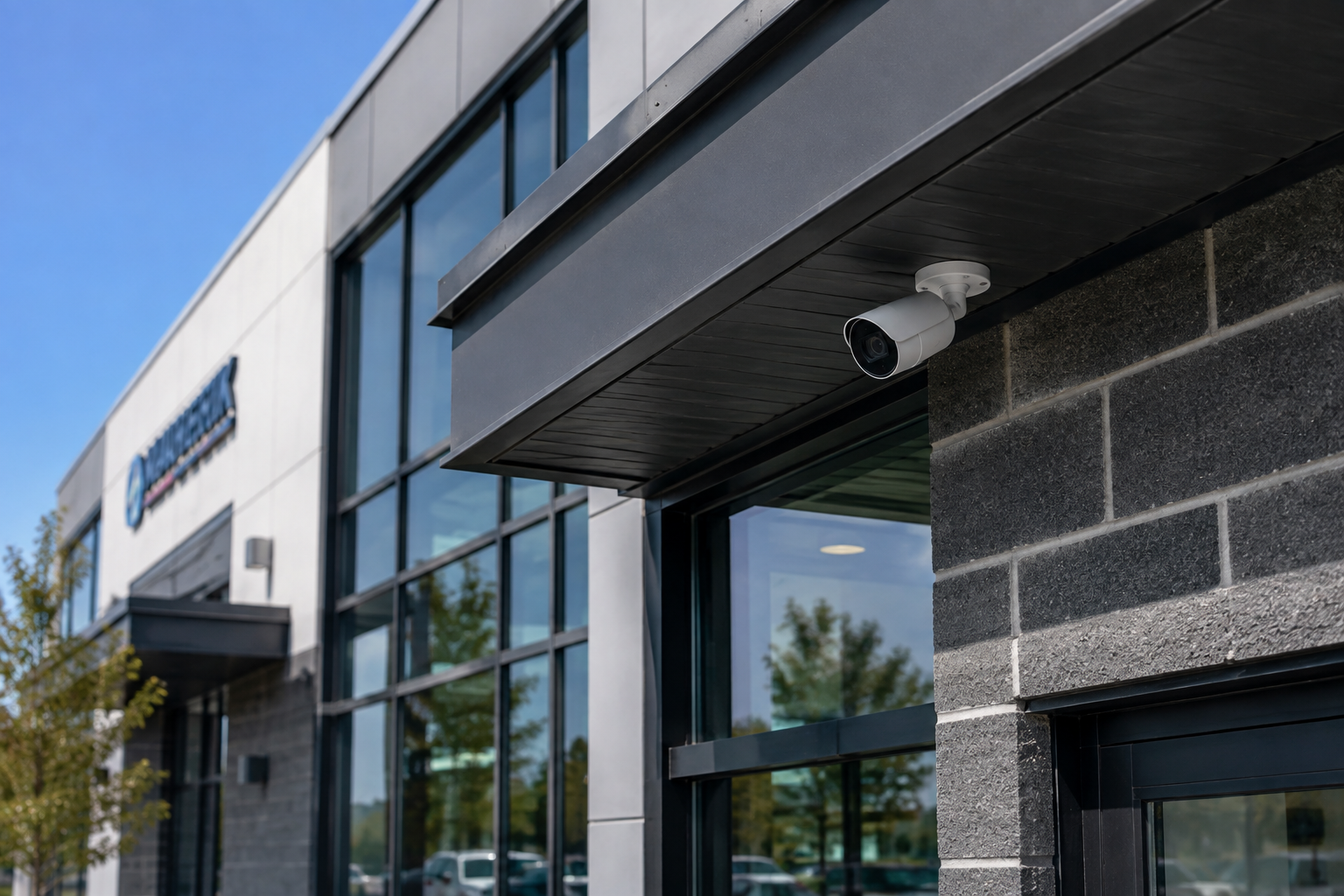
Bullet camerasare the visible, cylindrical style you’ll see mounted outside warehouses and parking lots. Their obvious presence works as a deterrent on its own, and they’re built to handle outdoor weather conditions.
Turret camerassit somewhere in between, with a ball-and-socket design that’s easy to angle precisely. They’ve become popular for storefronts that want strong image quality without the bulk of full dome housing.
PTZ cameras, short for pan-tilt-zoom, can be controlled remotely to follow movement across a large area, like a loading dock or open warehouse floor. They cost more, but one PTZ camera can sometimes cover ground that would otherwise take several fixed cameras.
License plate recognition cameras are also worth a look, especially if your business has parking lots or entry gates. They are so specialized that they can read plates clearly even when they are moving, something that standard cameras often struggle with.
Bergen County Specifics Worth Knowing
Local conditions matter more than people expect when planning a security system. A few things are worth keeping in mind if you’re operating here.
Weather is a real factor. Bergen County sees humid summers and snowy winters, so outdoor cameras need a solid IP rating, meaning they’re properly sealed against dust and moisture, along with a wide operating temperature range. Cutting corners here means replacing cameras sooner than you should.
You will also want to check insurance and local code requirements before you install anything. Some townships in Bergen County also have rules about where you can place your cameras, especially if they point towards a neighboring property or public sidewalk. Your insurance provider may also give you a premium discount if you have a professionally installed, hardwired system as this is viewed as more reliable than a DIY system.
Lastly, take into account crime trends that are particular to your industry and location. A retail store on a busy corridor in Hackensack faces different risks than a warehouse near the Meadowlands. A security installer in your area will know these patterns and can help you position your cameras where they can do the most good.
What It Costs, and Why It’s Worth It
Hardwired commercial systems cost more upfront than a box of DIY cameras from a big-box store. There’s no getting around that. Cabling, professional installation labor, and commercial-grade equipment all add to the price tag.
But it’s not an apples-to-apples comparison. DIY systems frequently require replacement or significant supplementation within a couple of years, particularly once a business scales up. A good hardwired system is built to last ten years or more with basic maintenance, so that upfront cost gets spread out quite a bit.
There’s the liability angle too. If something happens on your property and your camera footage is unreliable, grainy or missing entirely due to a Wi-Fi dropout, that’s a real problem for insurance claims, employee disputes or even law enforcement investigations. Reliable footage is not a luxury. That’s part of protecting your business.
Installation and Ongoing Maintenance
A hardwired system is not a DIY camera kind of weekend project. There is real expertise involved in running cable through walls and ceilings, mounting cameras at the proper height and angle and properly configuring an NVR or DVR.
That said, once installed correctly it’s fairly low maintenance. Usually cleaning the lens, updating the firmware, checking the hard drive once in a while is enough to keep the system running smoothly. Most local installers have service plans that can handle this for you so you don’t have to be the one climbing a ladder to clean a camera lens every few months.
Finding the Right Installer
Not every security company installs hardwired systems the same way, so it pays to ask questions before signing a contract. Find out whether they specialize in commercial installations specifically, not just residential work. At Gladiator Alarms, we specialize in commercial security and camera systems.
We can give you detailed information about the camera and recorder brands we recommend, including whether they have a track record of reliability and long-term firmware support. A company familiar with Bergen County’s local permitting and township rules will also save you time and hassle down the road.
A hardwired system, whether analog or IP-based, gives you reliable footage, stronger security, and a setup that’s built to grow with your business. For Bergen County business owners, that reliability isn’t just about catching an incident on camera. It’s about having a system you can actually count on when it matters most.

Mike has been in the industry since 2000. After working for local Bergen County-established electrical contractors and completing a 5-year state-sanctioned apprenticeship program, Mike became a foreman for a large company where he remained for over a decade. As an accomplished Martial artist in Brazilian jiu jitsu , Muay Thai & boxing Mike has learned focus, tolerance, fairness, humbleness, discipline and personal growth.
Leave a Reply